
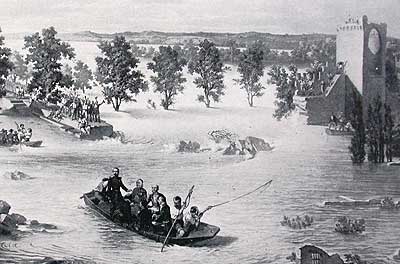
 / Napoleon III visits Avignon during the floods of 1856
Under the Restoration, royalism was strong in several parts of Provence. Political loyalties nevertheless differed among towns and social groups. The Revolution of 1830, which brought Louis-Philippe to power, changed these balances without erasing the divisions inherited from earlier decades.
Economic developments transformed society. Marseille expanded trade and industry, while the Rhône Valley's towns and the countryside followed different paths. These changes were accompanied by a diversification of political commitments.
The Revolution of 1848 and the proclamation of the Republic encouraged new political mobilisation. After Louis-Napoleon Bonaparte's coup on 2 December 1851, strong republican resistance developed, particularly in the Var and Basses-Alpes. The army suppressed it; many opponents were imprisoned, deported or forced into exile, particularly in Algeria.
 / Frédéric Mistral, painted by Paul Saïn
The Second Empire brought industrial growth and major urban change. The railway network gradually connected Marseille with Paris and the coastal towns, while ports and industrial districts expanded. Nice and its county became part of France in 1860. Marseille's population grew substantially during the nineteenth century.
Founded in 1854 by seven poets, including Frédéric Mistral and Joseph Roumanille, the Félibrige defends and promotes Provençal language and literature. Mistral received the Nobel Prize in Literature in 1904.
Sources and further reading: Félibrige: its founders and terminology; Nobel Foundation: the 1904 Literature Prize.