
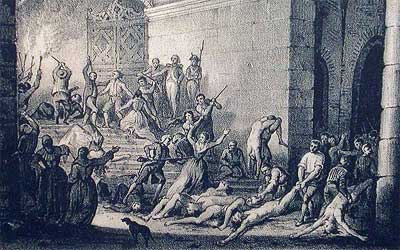
 / The Glacière massacre in the Palace of the Popes, Avignon
In 1789, part of Provence's population welcomed the Revolution. Social tensions were high after the harsh winter of 1788–1789. Privileges were challenged as political mobilisation spread through towns and countryside.
Political conflict sometimes led to violent rioting. In Avignon in October 1791, around sixty prisoners were killed in the Palace of the Popes in the Glacière massacre.
In 1790, the Constituent Assembly abolished the old parlements and reorganised the territory into departments, including the Bouches-du-Rhône, Var and Basses-Alpes. Avignon and the Comtat Venaissin were united with France in 1791 after heated debate and local conflict. The Vaucluse department was created in 1793.
In 1792, action against seigneurial rights and châteaux continued in some rural areas. In the towns, divisions among revolutionary movements deepened.
In 1793, several southern towns joined the so-called Federalist revolts against the Montagnard-dominated Convention. Marseille's forces were defeated. In Toulon, royalists gained the upper hand and handed the port to Anglo-Spanish forces. The republican army recaptured the city in December. Repression and the Terror left a deep mark on this period.
After Robespierre's fall in July 1794, the balance of power shifted. In 1795, the White Terror brought violence against former revolutionary activists. These acts of revenge prolonged the region's political and social divisions.
Sources and further reading: Musée national de la Marine: the siege of Toulon in 1793; Historical research: crimes of the White Terror.