
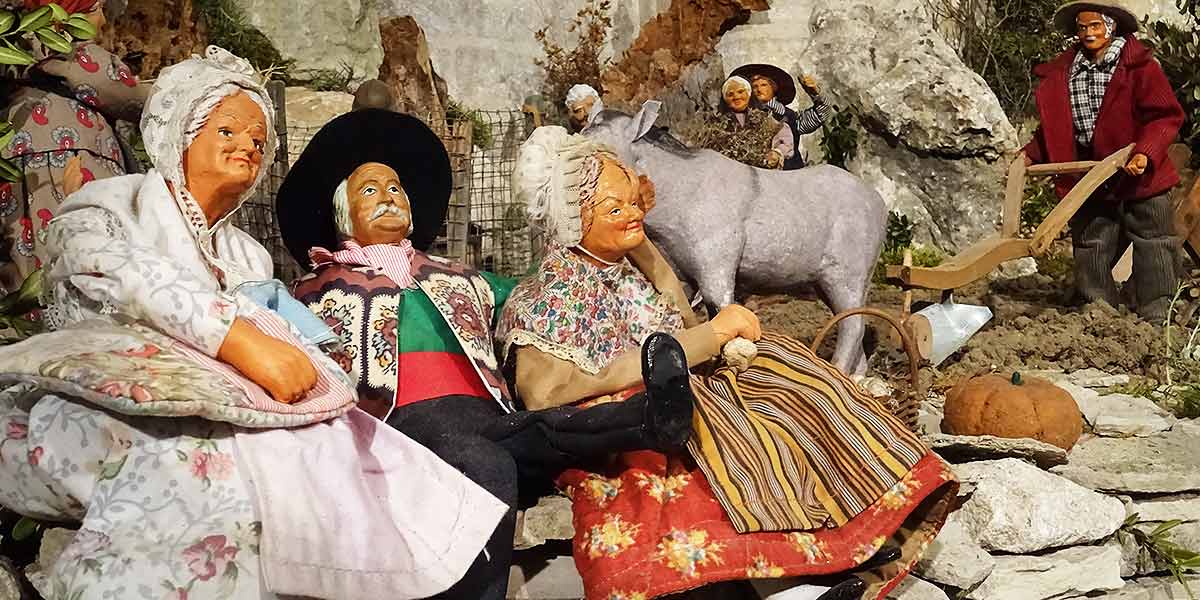
The world of Provençal santons
From portraits of makers to the miniature landscapes of nativity scenes
A face, a pose, a fold in a garment: santons reveal themselves when you take time to look. Behind these little figures are skilled hands, choices of material and a personal way of depicting Provence.
This trail begins with four portraits of santon makers, then opens out into the settings of the nativity scenes in Banon and Bonnieux. These are two complementary approaches: looking closely at a creation, then discovering scenes in which figures take their place.
These photographs and encounters come from the Horizon Provence archives. To plan a visit to a nativity scene, consult the dated announcements on the report pages.
1. Isoline Fontanille: the work of the studio

The portrait of Isoline Fontanille takes us into a family studio in Pujaut. It follows the stages of santon making, from the clay model to finishing and colour.
The figures in the photographs show how poses and details give each character its own presence. This first stop invites a closer look at the work behind the little figure.
2. Jean-Marie Fontanille: the character of each figure

The report on Jean-Marie Fontanille looks closely at individually modelled pieces. Faces, hands and clothing form characters that reward a long look.
Close-up photographs reveal the attention to detail. They show another way of approaching a santon: as a small sculpture in its own right.
3. Liliane Guiomar: scenes full of expression

The photographs in this report were taken at the international santon makers’ exhibition in Arles. They present the world of Liliane Guiomar, in which expressions, drapery and the composition of scenes play an important role.
The eye moves from one figure to another, discovering inspirations that extend beyond Provence. The portrait invites an appreciation of the artistic variety within the world of santons.
4. Magali Montagard: an encounter at La Crémade

The report preserves the memory of a visit to Magali Montagard’s workshop at La Crémade. It presents traditional unfired-clay santons, dried in the sun, and the atmosphere of this place of creation.
The figures, the objects in the workshop and the portrait of their maker together tell a story of family transmission and attachment to Provençal folk traditions.
5. Banon: santons in a miniature landscape

With the nativity scene in Banon, the trail changes scale. The figures become part of a broad setting that evokes the village, the countryside and the activities of Provence in earlier times.
The photographic report moves from an overall view to individual scenes. Buildings, paths and landscape details invite you to discover what is happening in every corner.
6. Bonnieux: the nativity scene in the upper church

In the photographs of the Bonnieux nativity scene, santons stand among dry-stone features and miniature landscapes reminiscent of the village surroundings.
This final stop brings the figures and their setting together. It follows the exploration of workshops with the pleasure of looking at a complete nativity scene, then discovering its details.