


1947 > 1948 > 1949 > 1950 > 1951 > 1952 > 1953 > 1954 > 1955 > 1956 > 1957 > 1958 > 1959 > 1960 > 1961 > 1962 > 1963 > 1964 > 1965 > 1966 > 1967 > 1968 > 1969 > 1970 > 1971 > 1972 > 1973 > 1974 > 1975 > 1976 > 1977 > 1978 > 1979 > 1980 > 1981 > 1982 > 1983 > 1984 > 1985 > 1986 > 1987 > 1988 > 1989 > 1990 > 1991 > 1992 > 1993 > 1994 > 1995 > 1996 > 1997 > 1998 > 1999 > 2000 > 2001 > 2002 > 2003 > 2004 > 2005 > 2006 > 2007 > 2008 > 2009 > 2010 > 2011 > 2012
From the first Semaine d’art to the early twenty-first century, this chronology brings together posters, selected programmes and historical milestones. Dates and positions refer to the period described. Play titles are retained in French as listed in the original programmes.
1947 — 1st Festival d’Avignon
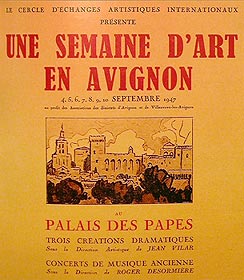
René Char and Christian Zervos invited Jean Vilar to present a week of drama in Avignon alongside an exhibition of contemporary painting and sculpture at the Palais des Papes.
Jean Vilar proposed three productions in different venues. The Cour d’honneur hosted William Shakespeare’s La Tragédie du roi Richard II. Two contemporary works completed the programme: Paul Claudel’s Histoire de Tobie et de Sara and Maurice Clavel’s La Terrasse de midi.
This first edition, known as the “Semaine d’art dramatique”, ran from 4 to 10 September 1947.
1948 — 2nd Festival d’Avignon
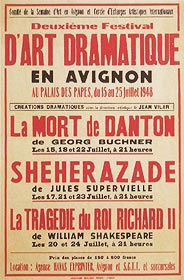
Jean Vilar returned to the Palais des Papes in July. Avignon residents accommodated the actors and technicians, while soldiers from the 7th Engineer Regiment helped install the stage and seating.
Jean Vilar presented three plays:
- La Mort de Danton by Georg Büchner in the Cour d’honneur
- Shéhérazade by Jules Supervielle in the Verger Urbain V
- La Tragédie du Roi Richard II by William Shakespeare in the Cour d’honneur
1949 — 3rd Festival d’Avignon
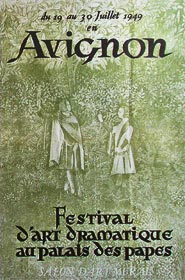
With Le Cid, Pierre Corneille entered the Palais des Papes’ Cour d’honneur. The French classical repertoire thus found its place in the young Festival.
In the Cour d’honneur that year:
- Le Cid by Corneille
- La Tragédie du Roi Richard II by William Shakespeare
In the Verger Urbain V:
- Pasiphaé by Henry de Montherlant
- Œdipe by André Gide
1950 — 4th Festival d’Avignon
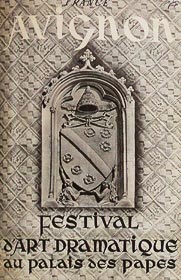
Shakespeare returned to the Cour d’honneur with Henri IV. Jean Vilar offered demanding works to a growing audience. The Avignon experience gave particular resonance to his commitment to popular theatre beyond the Parisian stage.
In the Cour d’honneur that year:
- Henri IV d'Angleterre by William
Shakespeare
- Le Cid by Corneille
In the Verger Urbain V:
- Le Profanateur by Thierry Maulnier
1951 — 5th Festival d’Avignon
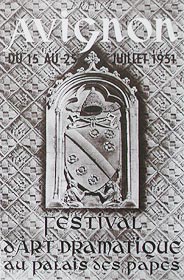
Gérard Philipe performed in Le Prince de Hombourg and Le Cid. Injured during rehearsals, he continued performing despite the pain. His presence left a lasting mark on the Festival and helped spread the influence of Jean Vilar’s theatrical venture.
Jean Vilar was appointed director of the Théâtre national populaire, or TNP, at the Palais de Chaillot in Paris. He hoped to extend the Avignon experience to a national audience.
At the Festival that year:
- Le Prince de Hombourg by Heinrich von Kleist (Cour d'Honneur)
- Le Cid by Corneille (Cour d'Honneur)
- La Calandria de Bernardo Dovizi (Verger Urbain V)
1952 — 6th Festival d’Avignon
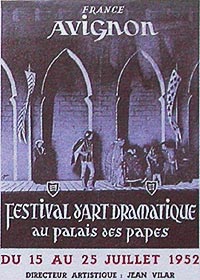
Gérard Philipe returned as the Prince of Homburg and performed in Alfred de Musset’s Lorenzaccio. This further success strengthened the bond between the actor, Jean Vilar and the Cour d’honneur audience.
Jean Vilar performed Molière’s L’Avare in the Verger Urbain V.
At the Festival that year:
- Le Prince de Hombourg by Heinrich von Kleist (Cour d'Honneur)
- Lorenzaccio d'Alfred de Musset (Cour d'Honneur)
- L'Avare by Molière (Verger Urbain V)
1953 — 7th Festival d’Avignon
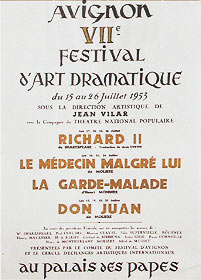
Molière took centre stage as Dom Juan and his servant Sganarelle entered the Palais des Papes, played by Jean Vilar and Daniel Sorano.
Georges Wilson of the TNP directed Henri Monnier’s La Garde-malade in the Verger Urbain V.
At the Festival that year:
- Don Juan de Molière (New production - Cour d'Honneur)
- Richard II de William Shakespeare (Cour d'Honneur)
- Le médecin malgré lui by Molière (Verger Urbain V)
- la Garde malade by Henri Monnier (New production - Verger Urbain V)
1954 — 8th Festival d’Avignon
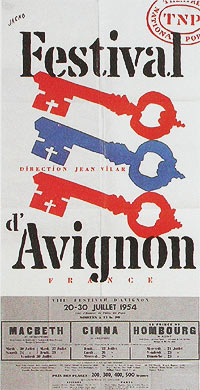
Jean Vilar directed and performed in Pierre Corneille’s Cinna and Shakespeare’s Macbeth, with Maria Casarès among his fellow actors.
The TNP, directed by Jean Vilar, organised the Festival. Debates in the Verger complemented the performances, putting into practice the ideal of a theatre engaged with civic life.
At the Festival that year:
- Macbeth de William Shakespeare (New production - Cour d'Honneur)
- Cinna de Pierre Corneille (Cour d'Honneur)
- Le Prince de Homburg de
Heinrich von Kleist (Cour d'Honneur)
- Débats et rencontres au Verger Urbain V
1955 — 9th Festival d’Avignon
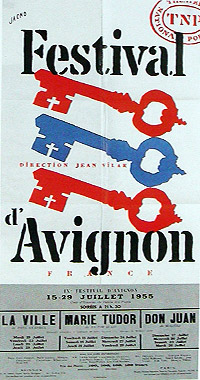
Paul Claudel and Victor Hugo occupied the Cour d’honneur with La Ville and Marie Tudor, the latter featuring Maria Casarès. Conferences and discussions multiplied. That summer, the CEMEA organised the first international youth meetings.
At the Festival that year:
- Marie Tudor de Victor Hugo (New production - Cour d'Honneur)
- La Ville de Paul Claudel(Cour d'Honneur)
- Dom Juan de
Molière (Cour d'Honneur)
- Exposition Rouault - Dommier
organisée par les ATP du Nord dans l'Hôtel
de Ville
- Premières "Rencontres internationales de jeunes" organisées par les CEMEA
1956 — 10th Festival d’Avignon
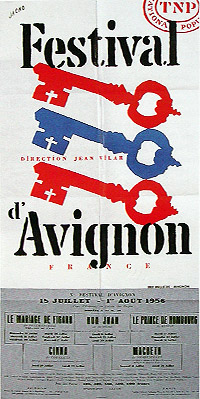
For the tenth edition, five productions were presented in the Cour d’honneur, including a new staging of Beaumarchais’s Le Mariage de Figaro.
In an assessment entitled “Les dix ans d’Avignon”, Jean Vilar reflected on the Festival experience and its growing success.
At the Festival that year:
- Le Mariage de Figaro de Beaumarchais (New production - Cour d'Honneur)
- Dom Juan de Molière (Cour d'Honneur)
- Le Prince de Hombourg by Heinrich von Kleist (Cour d'Honneur)
- Cinna by Pierre Corneille (Cour d'Honneur)
- Macbeth by Shakespeare (Cour d'Honneur)
Conférences organisées par les ATP d'Avignon
1957 — 11th Festival d’Avignon
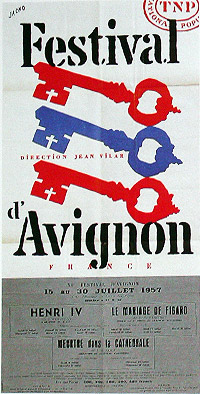
Ten years after the first edition, Jean Vilar took on two new roles: Luigi Pirandello’s Henri IV and T. S. Eliot’s Meurtre dans la cathédrale, in which he played the Archbishop of Canterbury.
In the Cour d’honneur that year:
- Henri IV de Luigi Pirandello (création)
- Meurtre à la cathédrale de T. S. Eliot (création)
- Le Mariage de Figaro de Beaumarchais
1958 — 12th Festival d’Avignon
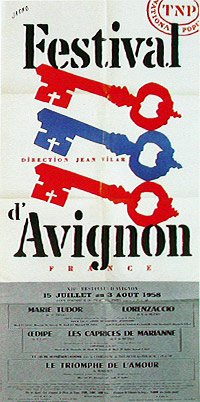
Gérard Philipe returned to Alfred de Musset with a new production of Les Caprices de Marianne and a revival of Lorenzaccio. The growing number of performances reflected the audience’s enthusiasm.
In the Cour d’honneur that year:
- Les Caprices de Marianne d’ Alfred de Musset (création)
- Œdipe d’ André Gide
- Lorenzaccio de Alfred de Musset
- Marie Tudor by Victor Hugo
The Festival also reached the Chartreuse in Villeneuve-lès-Avignon, which hosted:
- Le Triomphe de l'Amour de Marivaux
1959 — 13th Festival d’Avignon
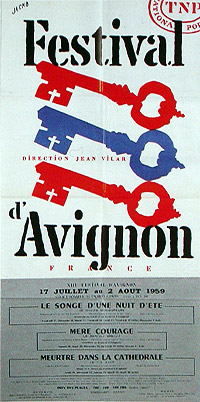
A new production of Shakespeare’s Le Songe d’une nuit d’été marked this edition. Bertolt Brecht’s Mère Courage, already in the TNP repertoire, was performed at the Festival for the first time. T. S. Eliot’s Meurtre dans la cathédrale also returned to Avignon.
In the Cour d’honneur that year:
- Songe d'une nuit d'été by William Shakespeare (création)
- Mère Courage de Bertolt Brecht
- Meurtre dans la cathédrale de TS Elliott
1960 — 14th Festival d’Avignon
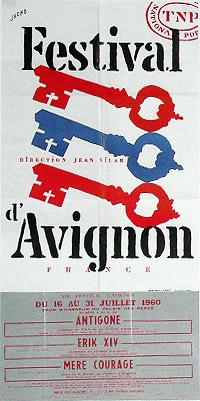
Jean Vilar presented Antigone, with Catherine Sellers in the title role and Georges Wilson as Creon, to music by André Jolivet. This edition paid tribute to Gérard Philipe, who had died in November 1959.
In the Cour d’honneur that year:
- Antigone by Sophocle (création)
- Erick XIV de August Strindberg
- Mère Courage de Bertolt Brecht
1961 — 15th Festival d’Avignon
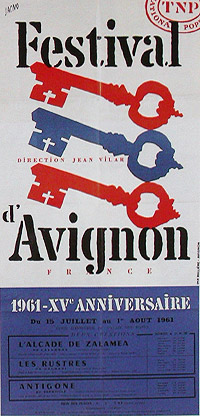
During the Algerian War, Jean Vilar offered a programme exploring civic life and justice: Calderón’s L’Alcade de Zalamea, Sophocles’s Antigone and Carlo Goldoni’s Les Rustres.
In the Cour d’honneur that year:
- l'Alcade de Zalamea de Calderón (création)
- Les Rustres by Carlo Goldoni
- Antigone de Sophocle
1962 — 16th Festival d’Avignon
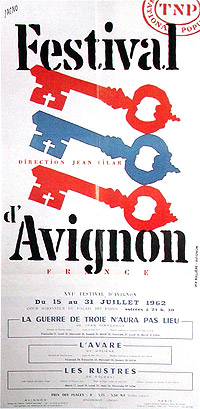
With La guerre de Troie n’aura pas lieu, Jean Giraudoux entered the Cour d’honneur. Jean Vilar also revived L’Avare, ten years after its first Avignon presentation, with Philippe Avron as La Flèche. Paul Puaux noted how Vilar’s interpretation of Harpagon had deepened and become more assured over time.
In the Cour d’honneur that year:
- La guerre de Troie n'aura pas lieu de Jean Giraudoux
- L'Avare by Molière
- Les Rustres by Carlo Goldoni
1963 — 17th Festival d’Avignon
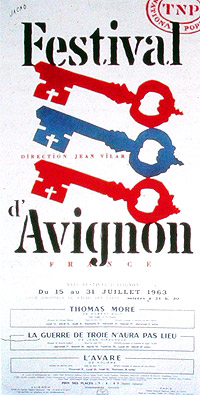
Jean Vilar left the TNP, where Georges Wilson succeeded him as director. He concentrated on the Festival and presented his last Avignon production, Robert Bolt’s Thomas More ou l’Homme seul.
In the Cour d’honneur that year:
- Thomas More by Robert Bolt
- La guerre de Troie n'aura pas lieu by Jean Giraudoux
- L'Avare by Molière
1964 — 18th Festival d’Avignon
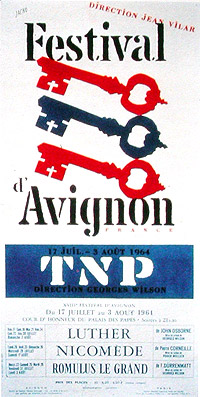
Two longstanding collaborators of Jean Vilar featured in the programme: Georges Wilson directed John Osborne’s Luther and Friedrich Dürrenmatt’s Romulus le Grand; Roger Mollien presented Pierre Corneille’s Nicomède.
Jean Vilar organised the first Rencontres d’Avignon, a series of discussions on the relationship between culture and politics.
In the Cour d’honneur that year:
- Luther by John Osborne
- Nicomède by Pierre Corneille
- Romulus le Grand by Friedrich Dürrenmatt
1965 — 19th Festival d’Avignon
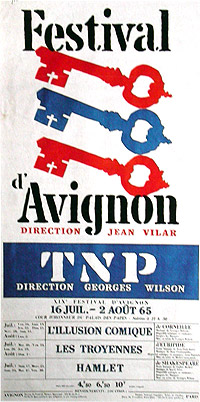
Three TNP productions occupied the Cour d’honneur: Corneille’s L’Illusion comique and Shakespeare’s Hamlet, directed by Georges Wilson, and Euripides’s Les Troyennes, staged by Michel Cacoyannis.
The Festival filled the stands. Jean Vilar wanted Avignon to be a place for reflection as well as performance: the second Rencontres d’Avignon took “School and culture” as their theme.
In the Cour d’honneur that year:
- L'Illusion comique de Pierre Corneille
- Hamlet by Shakespeare
- Les Troyennes d'Euripide
1966 — 20th Festival d’Avignon
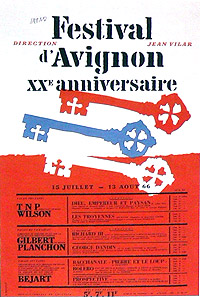
For the twentieth edition, Jean Vilar renewed the Festival’s format and gave it fresh momentum.
The Festival expanded from two to four weeks and welcomed three companies instead of one. Roger Planchon and the Théâtre de la Cité presented Shakespeare and Molière in front of the Palais. Maurice Béjart’s Ballet du XXe siècle gave dance a new place in the Cour d’honneur.
In the Cour d’honneur that year:
- Dieu, Empereur et Paysan de Julius Hay
- Les Troyennes d'Euripide
- Bacchanale, Pierre et le Loup, Bolero (dance) par Ballet du XXème siècle - Maurice Béjart
- Prospective (dance) par Ballet du XXème siècle - Maurice Béjart
In front of the vice-legate’s palace:
- Richard III de Shakespeare
- George Dandin de Molière
1967 — 21st Festival d’Avignon
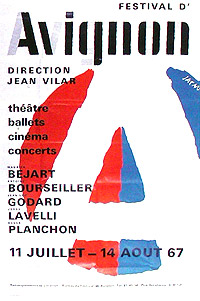
The Festival continued to broaden its scope: cinema in the Cour d’honneur, contemporary music in the Verger and contemporary playwrights in the Cloître des Carmes. Roger Planchon and Maurice Béjart returned.
Jean Vilar wanted Avignon to be a place of creation and expression, a laboratory for live performance. For four weeks, productions and discussions transformed the rhythm of city life.
André Benedetto presented Napalm at the Théâtre des Carmes outside the official programme. The production contributed to the growth of the Off Festival, whose beginnings date to 1966.
In the Cour d’honneur that year:
- Bleus, blancs, rouges ou les Libertins de Roger Planchon
- Le Tartuffe by Molière (directed by Roger Planchon)
- Le Triomphe de la sensibilité de Goethe (directed by Jorge Lavelli)
- Médée de Sénèque (directed by Jorge Lavelli)
- Messe pour le temps présent (dance) par Ballet du XXème siècle - choreography Maurice Béjart
- Roméo et Juliette (dance) par Ballet du XXème siècle - choreography Maurice Béjart
- La Chinoise (cinéma) de Jean-Luc Godard
1968 — 22nd Festival d’Avignon
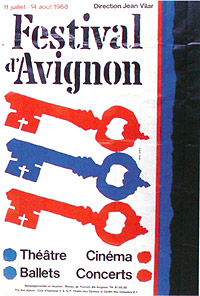
In the aftermath of May 1968, the Festival also became a place of political and artistic protest. The openness Jean Vilar sought encountered the tensions of the period.
The banning of a production in Villeneuve-lès-Avignon intensified the conflict. Protesters called for the Festival to stop, while the Living Theatre took part in the protests. Jean Vilar kept performances going, but the edition affected him deeply.
In the Cour d’honneur that year:
- Ni fleur ni couronnes - Le sacre du printemps (dance) par Ballet du XXème siècle - Maurice Béjart
- Roméo et Juliette (dance) par Ballet du XXème siècle - Maurice Béjart
- Messe pour le temps présent (dance) par Ballet du XXème siècle
- A la recherche de... : Cantates - Nuit obscure - Bakhti (dance) par Ballet du XXème siècle
In the Cloître des Carmes:
- Antigone par Living theatre (directed by Judith Malina et Julian Beck)
- Mysteries and smaller pieces par Living theatre (directed by Judith Malina et Julian Beck)
- Paradise Now par Living theatre (directed by Judith Malina et Julian Beck)
1969 — 23rd Festival d’Avignon
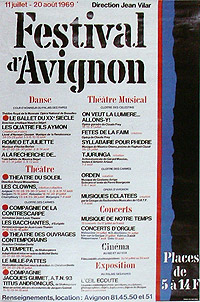
Ariane Mnouchkine and the Théâtre du Soleil presented Les Clowns at the Collège Saint-Joseph and later outdoors in a meadow. Their appearance marked another step in the Festival’s broadening outlook.
Music theatre found a place in the Cloître des Célestins.
The Cour d’honneur hosted three productions by Maurice Béjart’s Ballet du XXe siècle.
In the Cour d’honneur that year:
- Les Quatre fils Aymon (dance) par Ballet du XXème siècle - choreography Maurice Béjart
- Roméo et Juliette (dance) par Ballet du XXème siècle - choreography Maurice Béjart
- A la recherche de... : L'Art de la barre / Cantates / Nuit obscure / Bakhti / Hikio / Nomos Alpha (dance) par Ballet du XXème siècle - choreography Maurice Béjart
1970 — 24th Festival d’Avignon
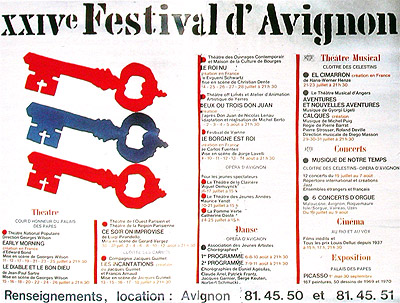
An exhibition of recent Picasso paintings occupied the Palais des Papes’ Grande Chapelle and marked this twenty-fourth edition.
The Off Festival gained momentum. Young companies came to Avignon to meet the audiences, professionals and journalists gathered there during the summer.
In the Cour d’honneur that year:
- Early Morning de Edward Bond directed by Georges Wilson
- Le Diable et le Bon Dieu de Jean-Paul Sartre, Mise en scène de Georges Wilson
- Ce soir on improvise de Luigi Pirandello, directed by Gérard Vergez
1971 — 25th Festival d’Avignon
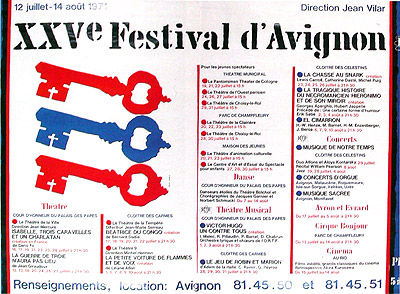
Jean Vilar died a few weeks before the Festival opened. Paul Puaux, his colleague since the early days, succeeded him as director.
At the Chapelle des Pénitents Blancs, Lucien Attoun launched Théâtre Ouvert. Actors presented unpublished texts by contemporary playwrights with deliberately minimal staging.
The Off Festival continued to develop in venues around the city.
In the Cour d’honneur that year:
- Isabelle, trois caravelles et un charlatan by Dario Fo directed by de Arturo Corso
- La Guerre de Troie n'aura pas lieu de Jean Giraudoux, Mise en scène de Jean Mercure
- Maïa Plissetskaä et des danseurs du Théâtre Bolchoï de Moscou (dance)
1972 — 26th Festival d’Avignon
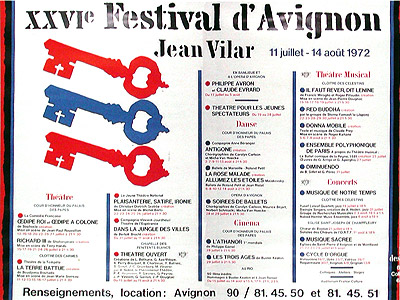
Paul Puaux directed the twenty-sixth edition. The Comédie-Française was invited to the Cour d’honneur. In the Cloître des Carmes, Jean-Pierre Vincent directed Bertolt Brecht’s Dans la jungle des villes.
Growing success also raised a question: how could artistic exploration be preserved within an event attracting ever larger audiences?
In the Cour d’honneur that year:
- Œdipe roi / Œdipe à Colone by Sophocle directed by de Jean-Paul Roussillon (Comédie-Française)
- Richard III de Shakespeare, Mise en scène de Terry Hands (Comédie-Française)
- Rituel pour un rêve mort choreography by Carolyn Carlson / Antigone choreography by Micha Van Hoecke (dance)
- Divertissement / Allumez les étoiles : Maïakovski choreography de Roland Petit (dance)
1973 — 27th Festival d’Avignon
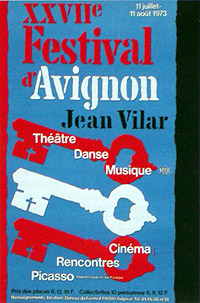
André Benedetto presented La Madone aux ordures in the Cloître des Carmes after its premiere in the Off the previous year. The invitation demonstrated exchanges between the two festivals.
In the Cour d’honneur, Marcel Maréchal directed Jacques Audiberti’s Le Cavalier seul.
The Palais des Papes’ Grande Chapelle hosted another exhibition of recent Picasso paintings.
In the Cour d’honneur that year:
- Onicri by et par Antoine Bourseiller choreography by Carolyn Carlson
- Le Cavalier Seul de Jacques Audiberti, Mise en scène de Marcel Maréchal
- Le Quichotte de Serge Ganzl, Mise en scène de Gabriel Garran
- Mistero Buffo by Dario Fo Mise en scène de Arturo Corso
- Sparagmos choreography de Jean-Marie Marion (dance)
1974 — 28th Festival d’Avignon
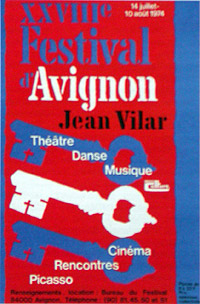
Exploration of music theatre continued with Ubu à l’opéra, composed by Antoine Duhamel after Alfred Jarry and directed by Georges Wilson in the Cloître des Célestins.
Lucien Attoun created the Gueuloir at the Chapelle des Cordeliers: contemporary playwrights presented their own texts to the audience without theatrical staging.
In the Cour d’honneur that year:
- Hölderlin by Peter Weiss directed by Marcel Maréchal
- La Poupée de Jacques Audiberti, directed by Marcel Maréchal
- Fracasse de Serge Ganzl, directed by Marcel Maréchal
- The Alvin Ailey City Center Dance Theatre (USA) (dance)
- Ekaterina Maximova, Vladimir Vassiliev et le Ballet national de Cuba (dance)
- Danse et musiques de l'Inde (dance)
1975 — 29th Festival d’Avignon
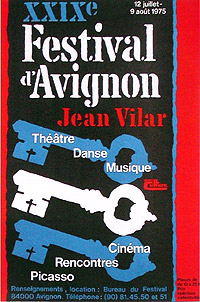
The Festival’s success grew, drawing large audiences to a programme spanning several disciplines.
Paul Puaux sought a balance between the event’s scale and the spirit of exploration inherited from Jean Vilar. Avignon remained a distinctive artistic and intellectual venture.
Mime artist Marcel Marceau occupied the vast Cour d’honneur stage alone.
In the Cour d’honneur that year:
- Coquin de Coq by Sean O'Casey directed by Guy Rétoré
- Othello de Shakespeare , directed by Georges Wilson
- Carolyn Carlson (dance)
- Ballets Félix Blaska (dance)
- Marcel Marceau (mime - théâtre de geste)
1976 — 30th Festival d’Avignon
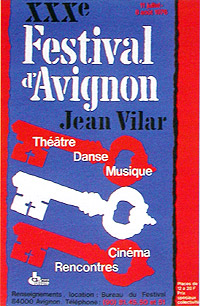
The thirtieth edition affirmed its international outlook. The Salle Benoît XII hosted productions from Quebec and the French Caribbean, while Merce Cunningham danced in the Cour d’honneur. At the municipal theatre, Robert Wilson and Philip Glass presented Einstein on the Beach, a landmark in contemporary opera.
In the Cour d’honneur that year:
- Comme il vous plaira by Shakespeare directed by Benno Besson
- Dans les eaux glacées du calcul égoïste directed by Mehmet Ulusoy
- Merce Cunningham and Dance Company (USA) choreography by Merce Cunningham (dance)
- Etoiles familières d'Avignon (dance)
- Ballet Malegot de Leningrad (dance)
1977 — 31st Festival d’Avignon
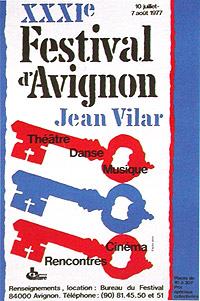
Benno Besson directed La Tragique Histoire de Hamlet, prince de Danemark, with Philippe Avron in the title role. Despite the actor’s performance, the production divided audiences and critics.
Gérard Gélas, a figure from the early days of the Off, welcomed a loyal audience to the Théâtre du Chêne Noir.
In the Cour d’honneur that year:
- La Tragique histoire de Hamlet, Prince de Danemark by Shakespeare directed by Benno Besson
- L'Otage de Paul Claudel directed by Guy Rétoré
- The Alvin Ailey City Center Dance Theatre (USA) (dance)
1978 — 32nd Festival d’Avignon
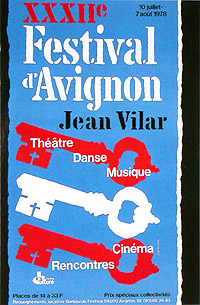
Brecht and Beckett occupied the Cour d’honneur with Le Cercle de craie caucasien and En attendant Godot. The productions proved popular with audiences.
In the Cloître des Carmes, Antoine Vitez made an impact with a young company and four Molière plays: L’École des femmes, Dom Juan, Le Misanthrope and Tartuffe.
In the Cour d’honneur that year:
- Le Cercle de Craie caucasien by Bertolt Brecht directed by de Benno Besson
- En attendant Godot by Samuel Beckett directed by Otomar Krejca
- Alwin Nikolais Dance Theatre (dance)
1979 — 33rd Festival d’Avignon
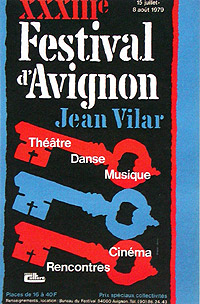
Peter Brook presented La Conférence des oiseaux in the Cloître des Carmes. At Champfleury, Ariane Mnouchkine and the Théâtre du Soleil offered Mephisto after Klaus Mann. This diversity marked the thirty-third edition.
The Festival attracted an ever-growing audience.
At the end of the edition, Paul Puaux left the directorship to concentrate on the Maison Jean Vilar, dedicated to preserving and sharing the Festival’s history.
In the Cour d’honneur that year:
- Lorenzaccio by Alfred de Musset directed by Otomar Krejca
- En attendant Godot by Samuel Beckett directed by Otomar Krejca
- Twyla Tharp and Dancers (USA) (dance)
1980 — 34th Festival d’Avignon
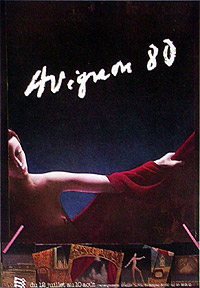
Bernard Faivre d’Arcier, a senior official at the Ministry of Culture, succeeded Paul Puaux as Festival director.
The thirty-fourth edition was a transitional one. The new director assembled a programme continuing his predecessor’s work while preparing the event’s development.
Stage forms took on particular importance. In the Cour d’honneur, Jorge Lavelli presented Shakespeare’s Le Conte d’hiver in a visually elaborate production.
In the Cour d’honneur that year:
- Le Conte d'Hiver by Shakespeare directed by Jorge Lavelli
- La Malédiction d'après Eschyle et Sophocle directed by de Jean-Pierre Miquel
- Jennifer Muller and the Works (USA) (dance)
- Louis Falco Dance Company (USA) (dance)
1981 — 35th Festival d’Avignon
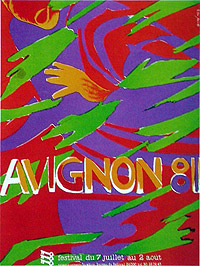
Elected President in May, François Mitterrand visited the Festival with Culture Minister Jack Lang. The period saw increased public support for culture.
Jean Gillibert, Daniel Mesguich and Robert Stouroua revisited classics in the Cour d’honneur. At the municipal theatre, Pina Bausch presented Kontakthof and 1980. In the Cloître des Carmes, Manfred Karge and Matthias Langhoff directed Büchner’s Woyzeck.
At the Théâtre de la Condition des Soies, Philippe Caubère premiered La Danse du diable. As writer, performer and director, he began a long autobiographical venture that would become Le Roman d’un acteur.
In the Cour d’honneur that year:
- Médée by Euripide directed by Jean Gillibert by la Comédie-Française.
- Le Roi Lear by Shakespeare directed by Daniel Mesguich
- Le Cercle de Craie caucasien de Bertolt Brecht directed by Robert Stouroua
- Richard III de Shakespeare directed by Robert Stouroua
- Nederland Dans Theatre (dance) choreographys de Jiri Kylian
1982 — 36th Festival d’Avignon
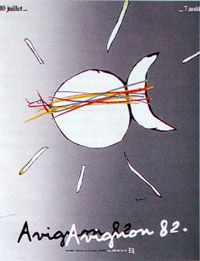
The Cour d’honneur changed with the rebuilding of its stands and a reduction in capacity to around 2,200 seats. Ariane Mnouchkine presented Shakespeare’s Richard II and La Nuit des rois there.
Jérôme Savary and the Grand Magic Circus presented Noël au front beneath a big top at the Clos de la Murette.
Italian actor Vittorio Gassman closed the Festival with two eagerly awaited performances in the Cour d’honneur.
Alain Léonard founded Avignon Public Off, an association that helped produce a shared programme for Off productions.
In the Cour d’honneur that year:
- La Nuit des Rois de Shakespeare directed by Ariane Mnouchkine
- Richard II de Shakespeare directed by Ariane Mnouchkine
- Les Possédés d'après Dostoïevski directed by Denis Llorca
- Gassman aux enchères by Vittorio Gassman
1983 — 37th Festival d’Avignon
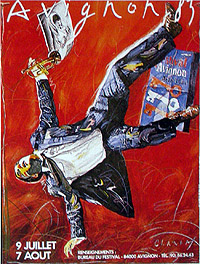
Bernard Faivre d’Arcier gave the thirty-seventh edition a thematic focus: relationships between human beings, space and new technologies.
Two contemporary playwrights featured in the Cour d’honneur: Bernard Chartreux with Dernières Nouvelles de la peste, directed by Jean-Pierre Vincent, and Jean-Christophe Bailly with Les Céphéides, directed by Georges Lavaudant.
With Nelken, Pina Bausch transformed the Cour d’honneur into a field of carnations. Dance also asserted itself through Régine Chopinot, Maguy Marin, Jean-Claude Gallotta and Jacques Garnier.
In the Cour d’honneur that year:
- Dernières nouvelles de la Peste de Bernard Chartreux directed by Jean-Pierre Vincent
- les Céphéïdes de Jean-Christophe Bailly directed by de Georges Lavaudant
- Nelken (Les Œillets) choreography by Pina Bausch (dance)
- L'Orso et la Luna choreography by Carolyn Carlson (dance)
1984 — 38th Festival d’Avignon
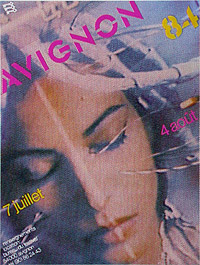
Bernard Faivre d’Arcier announced his departure. Alain Crombecque would succeed him for the 1985 edition.
In the Cour d’honneur, Ariane Mnouchkine and the Théâtre du Soleil continued their Shakespeare cycle with Henri IV.
At the municipal theatre, Manfred Karge and Matthias Langhoff presented Kleist’s Le Prince de Hombourg with Gérard Desarthe, thirty-three years after Gérard Philipe’s Avignon performance.
At the Cloître Saint-Louis, an exhibition explored the theme “The Living and the Artificial”.
In the Cour d’honneur that year:
- Richard II / La Nuit des Rois / Henri IV (1ère partie) de Shakespeare directed by Ariane Mnouchkine
- Richard III de Shakespeare directed by Georges Lavaudant
- Ulysse 84 (Les Œillets) choreography by Jean-Claude Gallotta (dance)
- Raymonda choreography de Rudolf Nureev, Inlets 2 choreography de Merce Cunningham, No Man's Land choreography by Rudolf von Dantzig, GV -10 choreography by Karole Armitage (dance)
1985 — 39th Festival d’Avignon
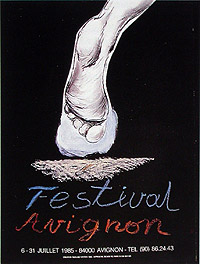
For Alain Crombecque’s first edition as director, Peter Brook presented Le Mahabharata, adapted by Jean-Claude Carrière. The Boulbon quarry hosted this long journey through the Indian epic, from sunset to dawn.
The Cour d’honneur hosted Victor Hugo’s Lucrèce Borgia and Shakespeare’s Macbeth.
At the Gymnase Aubanel, Tadeusz Kantor presented his distinctive theatrical world.
In the Cour d’honneur that year:
- La Tragédie Macbeth de Shakespeare directed by Jean-Pierre Vincent
- Lucrèce Borgia de Victor Hugo directed by de Antoine Vitez
- Inlets 2 / Roaratorio choreography by Merce Cunningham
1986 — 40th Festival d’Avignon
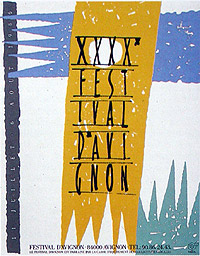
The Cour d’honneur was shared by Shakespeare’s La Tempête, directed by Alfredo Arias, and Mammame I et II, choreographed by Jean-Claude Gallotta.
Alain Crombecque continued to welcome contemporary writing, including works by Valère Novarina, Raoul Ruiz and Nathalie Sarraute.
In the Cour d’honneur that year:
- La Tempête de Shakespeare directed by Alfredo Arias
- Mammame I et II choreography de Jean-Claude Gallotta
- Esplanade / Runes / Roses choreography by Paul Taylor (dance)
- Intolérance by D.W. Griffith (cinéma)
1987 — 41st Festival d’Avignon
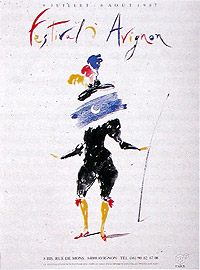
Antoine Vitez presented Paul Claudel’s complete Le Soulier de satin in the Cour d’honneur. From dusk to dawn, audiences followed a long theatrical journey that became part of Festival history.
Alain Crombecque continued a programme open to experimentation, including several Robert Pinget works in the Cloître des Carmes and the Pénitents Blancs and Cordeliers chapels.
Zingaro’s equestrian theatre presented its Cabaret équestre et musical and made a notable Festival debut.
Jérôme Deschamps presented Les Petits Pas at the municipal theatre, offering a distinctive form of popular theatre.
In the Cour d’honneur that year:
- Le Soulier de Satin de Paul Claudel directed by de Antoine Vitez
- Magnificat choreography de John Neumeier (dance)
- Martha Graham Dance Company choreography by Martha Graham (dance)
1988 — 42nd Festival d’Avignon
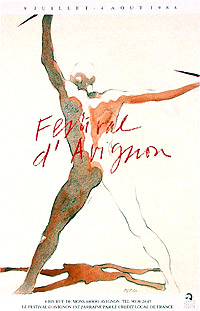
Shakespeare again featured prominently in the Cour d’honneur: Gérard Desarthe played Hamlet in Patrice Chéreau’s production, while Luc Bondy presented Le Conte d’hiver with Michel Piccoli.
Pierre Boulez brought his work to the Boulbon quarry and the Chartreuse in Villeneuve-lès-Avignon.
Theatre, music, dance and cinema intersected. Venues and disciplines diversified as the Festival welcomed artists from around the world.
In the Cour d’honneur that year:
- Hamlet de Shakespeare directed by Patrice Chéreau
- Le Conte d'Hiver de Shakespearedirected by Luc Bondy
- Five Stone Wind / Points in Space / Rain forest choreography by Merce Cunningham (dance)
1989 — 43rd Festival d’Avignon
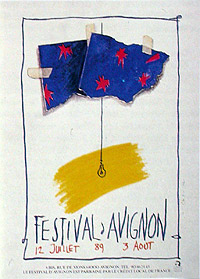
Jeanne Moreau, who had taken part in the first edition in 1947, returned to the Cour d’honneur for Fernando de Rojas’s La Célestine, directed by Antoine Vitez.
At the Boulbon quarry, Zingaro returned to an ever-growing audience.
At the Gymnase Aubanel, Jean-Pierre Vincent presented the trilogy Œdipe et les oiseaux: Sophocles’s Œdipe tyran and Œdipe à Colone, followed by La Cité des oiseaux after Aristophanes, in French texts by Bernard Chartreux.
Antoine Vitez also gave a reading of Aimé Césaire’s Discours sur le colonialisme.
In the Cour d’honneur that year:
- la Célestine de Fernando de Rojas directed by de Antoine Vitez
- Eh, qu'est-ce que ça me fait à moi ? choreography by Maguy Marin (dance)
- Rebonds a et b / Voyage absolu des Unari vers Andromède / Idmen A et B by Yannis Xenakis (musique contemporaine)
- Octobre réalisé par Eisenstein (URSS) (cinéma)
1990 — 44th Festival d’Avignon
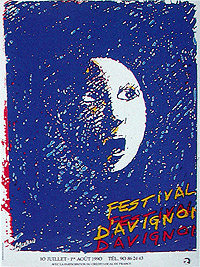
Jean-Pierre Vincent directed Les Fourberies de Scapin in the Cour d’honneur, with Daniel Auteuil, who grew up in Avignon, as Scapin.
At the Boulbon quarry, Jérôme Savary presented a Baroque and deliberately kitsch Le Songe d’une nuit d’été.
On the Place du Palais des Papes, Royal de Luxe told La Véritable Histoire de France in an exuberant street performance.
Several Southeast Asian dance groups presented episodes from the Ramayana, a great epic of Hindu tradition.
In the Cour d’honneur that year:
- Les Fourberies de Scapin de Molière directed by Jean-Pierre Vincent
- Concert hommage René Char musique et direction de Pierre Boulez (musique contemporaine)
- Khon (Ramayana) par le Ballet classique thaï de Bangkok (dance)
- Wayang orang (Ramayana) par le Ballet du Sultanat de Yogyakarta (dance)
1991 — 45th Festival d’Avignon
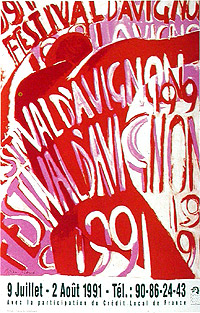
Bartabas and Zingaro, invited to the Festival since 1987, presented their Opéra équestre at the Boulbon quarry.
The Festival continued to explore venues beyond Avignon. Peter Brook presented Shakespeare’s La Tempête, in a French adaptation by Jean-Claude Carrière, at the quarry theatre in Les Taillades, at the foot of the Luberon.
In the Cour d’honneur that year:
- Les Comédies barbares de Ramon del Valle-Inclan directed by Jorge Lavelli
- Die Befragung des Robert Scott / Enemy in the figure / In the middle, somewhat elevated choreography by William Forsythe (dance)
- Récital Shahram Nazeri dans le cadre des Nuits persanes
1992 — 46th Festival d’Avignon
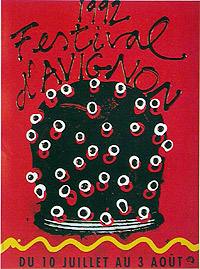
Five hundred years after Christopher Columbus’s voyage, the Festival gave prominence to Spanish and Latin American cultures.
Lope de Vega entered the Cour d’honneur with Le Chevalier d’Olmedo, with Jean-Marc Barr in the title role.
In Les Taillades, Georges Lavaudant presented Terra incognita. Artists from Mexico, Venezuela, Guatemala and Cuba also featured in the programme.
Alain Crombecque left the Festival to direct the Festival d’Automne in Paris. Bernard Faivre d’Arcier succeeded him.
On 16 July, a strike by performing-arts workers caused performances to be cancelled.
In the Cour d’honneur that year:
- Le Chevalier d'Olmedo de Lope de Vega directed by de Lluis Pasqual
- La Légende de Don Juan choreography by Jean-Claude Gallotta (dance)
- Mozart Concert Arias choreography by Anne Teresa De Keersmaeker (dance)
- Nuestra Historia al Sur musique et choreography by Pedro Bacan (music)
1993 — 47th Festival d’Avignon
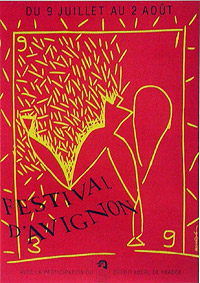
Bernard Faivre d’Arcier directed his first edition after returning to lead the Festival.
Forty years after Jean Vilar’s production, Jacques Lassalle and the Comédie-Française presented Molière’s Dom Juan in the Cour d’honneur.
Across eleven evenings, Philippe Caubère retraced his acting career and his experience with Ariane Mnouchkine’s Théâtre du Soleil.
Following Dominique Bagouet’s death in December 1992, his dancers gathered in the Cour d’honneur for a particularly moving tribute.
In the Cour d’honneur that year:
- Dom Juan de Molière directed by de Jacques Lassalle
- Jours étranges / So schnell choreography by Dominique Bagouet (dance)
- Noces / Parade choreography de Angelin Preljocaj (dance)
1994 — 48th Festival d’Avignon
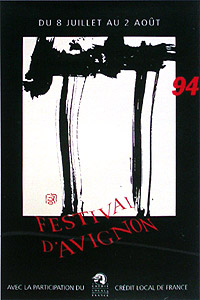
Japan featured prominently: Noh at the Boulbon quarry, comic and sung forms at the Chartreuse, and bugaku and butoh in the Cloître des Célestins.
Alain Françon directed Edward Bond’s Pièces de guerre, a stark sequence set in a devastated world.
In the Cour d’honneur that year:
- Andromaque d' Euripide directed by Jacques Lassalle
- Henri IV by Shakespeare directed by Stuart Seide
- In the middle somewhat elevated choreography by William Forsythe / Speaking in tongues choreography by Sandra Aberkalns / In the night choreography de Jérôme Robbins (dance)
1995 — 49th Festival d’Avignon
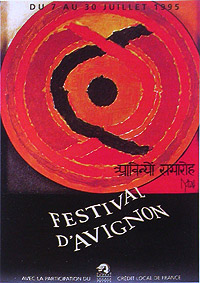
Pina Bausch opened the forty-ninth edition in the Cour d’honneur with Café Müller and Le Sacre du printemps.
Matthias Langhoff presented Shakespeare’s Richard III with students from the Théâtre national de Bretagne. The performance took audiences on a long tragicomic journey.
At the Gymnase Aubanel, Olivier Py presented La Servante, a cycle of five plays unfolding over twenty-four hours.
Ariane Mnouchkine offered a radical interpretation of Molière’s Tartuffe.
In the Cour d’honneur that year:
- Café Müller / Le Sacre du printemps choreography by Pina Bausch (dance)
- Les Pieds dans l'eau by Jérôme Deschamps directed by de Jérôme Deschamps
- Parcours choreography de Lucinda Child (dance)
1996 — 50th Festival d’Avignon
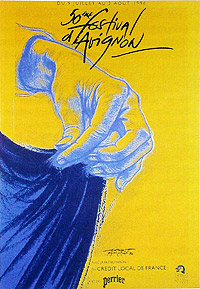
The fiftieth edition was celebrated in the Cour d’honneur with La Cour des comédiens. The anniversary edition offered a particularly broad programme.
Jacques Nichet directed Aimé Césaire’s La Tragédie du roi Christophe, which explores power in early nineteenth-century Haiti.
At the municipal theatre, the Berliner Ensemble presented Bertolt Brecht’s La Résistible Ascension d’Arturo Ui, directed by Heiner Müller, with Martin Wuttke in the title role.
In the Cour d’honneur that year:
- Edouard II by Christopher Marlowe directed by Alain Françon
- La Tragédie du roi Christophe d'Aimé Césaire directed by Jacques Nichet
- La Cour des Comédiens
- D-Man in the Waters / Sur la place / Ursonate choreography de Bill T. Jones (dance)
1997 — 51st Festival d’Avignon
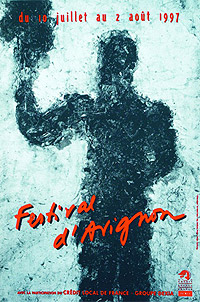
Russian theatre featured prominently, with Anatoli Vassiliev, Piotr Fomenko and Kama Guinkas. Amid difficult economic conditions for Eastern European artists, Bernard Faivre d’Arcier supported exchanges and productions through the Theorem network.
Sami Frey performed Lessing’s Nathan le Sage, a plea for tolerance, in the Cour d’honneur. Olivier Py also presented Le Visage d’Orphée there.
In the Cour d’honneur that year:
- Nathan le Sage by Gotthold Ephraïm Lessing directed by Denis Marleau
- Le Visage d'Orphée by Olivier Py directed by Olivier Py
- Dédale choreography de Philippe Genty (dance)
1998 — 52nd Festival d’Avignon
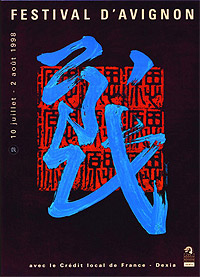
The Désirs d’Asie programme highlighted artists from Taiwan and Korea. The Boulbon quarry hosted several Korean performing traditions, while an adaptation of Macbeth in the Peking-opera tradition was presented in the Cour d’honneur.
The programme extended earlier openings towards India, Japan, Russia and Latin America. It reflected a desire to introduce audiences to different theatrical forms.
In the Cour d’honneur that year:
- Œdipe le tyran by Friedrich Hölderlin directed by Jean-Louis Martinelli
- Vie et mort du Roi Jean by William Shakespeare directed by Laurent Pelly
- Désir de Royaume dans le cadre de Désir d'Asie (Taïwan) (théâtre musical)
- Le Roi singe dans le cadre de Désir d'Asie (Taïwan) (théâtre musical)
1999 — 53rd Festival d’Avignon
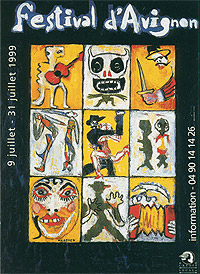
Shakespeare featured prominently. In the Cour d’honneur, Philippe Torreton performed Henry V, directed by Jean-Louis Benoit.
Angelin Preljocaj presented a choreography in which television imagery took on the features of a Gorgon.
Didier Bezace directed Bulgarian playwright Hristo Boytchev’s Le Colonel-oiseau.
At the Gymnase Aubanel, Rwanda 94, directed by Jacques Delcuvellerie, confronted audiences with the genocide against the Tutsi. The production brought together performers including Belgian and Rwandan artists.
In the Cour d’honneur that year:
- Henry V by William Shakespeare directed by de Jean-Louis Benoît
- Personne n'épouse les méduses choreography by Angelin Preljocaj (dance)
- Tango, vals y tango choreography de Ana Maria Steckelman (dance)
2000 — 54th Festival d’Avignon
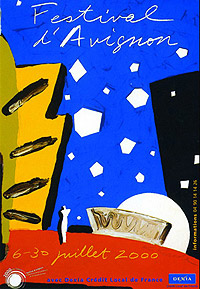
Avignon was one of nine European Capitals of Culture in 2000. At the Palais des Papes, the exhibition La Beauté in fabula brought older and contemporary artworks into dialogue.
Pina Bausch opened the Festival in the Cour d’honneur. In theatre, Jacques Lassalle presented Euripides’s Médée with Isabelle Huppert, in a translation that brought out the tragedy’s contemporary resonance.
In Hôtel Europa, audiences moved through rooms and corridors to discover several works from Eastern Europe.
At the Boulbon quarry, Philippe Caubère presented Claudine ou le théâtre, about his childhood and early theatrical experiences.
In the Cour d’honneur that year:
- Le laveur de vitre choreography by Pina Bausch directed by de Pina Bausch (dance)
- Médée d'Euripide directed by Jacques Lassalle
- Lorenzaccio by Alfred de Musset directed by Jean-Pierre Vincent
2001 — 55th Festival d’Avignon
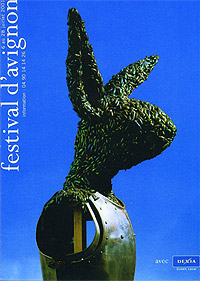
Didier Bezace directed Molière’s L’École des femmes in the Cour d’honneur, with Pierre Arditi as Arnolphe.
Jan Fabre presented Je suis sang, a “medieval fairy tale” combining theatre, dance and music. Also a visual artist, he created the work reproduced on that edition’s poster.
In the Cour d’honneur that year:
- L'école des femmes by Molière directed by Didier Bezace
- Félix Lajko concert de violon solo (musique)
- Je suis sang by Jan Fabre directed by Jan Fabre (danse - théâtre)
- Ritual récital de fado par Misia (music)
- You Walk ? choreography de Bill T. Jones (dance)
2002 — 56th Festival d’Avignon
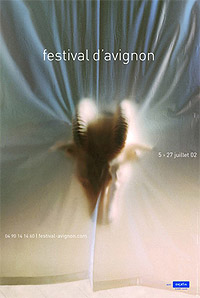
Éric Lacascade, noted for his Chekhov trilogy in 2000, returned with the playwright’s work in the Cour d’honneur.
Valérie Dréville performed Heiner Müller’s Médée-Matériau, directed by Anatoli Vassiliev.
In the Cour d’honneur that year:
- Platonov by Anton Tchekhov directed by Eric Lacascade
- noBody choreography de Sasha Waltz (dance)
- Tango by Julia Migenes (music)
2003 — 57th Festival d’Avignon
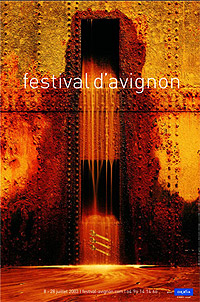
For the first time since its founding, the Festival d’Avignon was cancelled in its entirety.
Changes to performing-arts workers’ unemployment insurance, initiated by the June 2003 agreement, prompted widespread protest. A strike affected preparations for the Festival.
Rehearsals and technical installations were disrupted. The conditions needed to host performances and audiences could no longer be met.
Meeting at the Gymnase Aubanel, technicians, staff and artists debated continuing the action and voted to extend the strike.
In his final year as director, Bernard Faivre d’Arcier decided to cancel the edition. Tickets already sold were refunded.
Hortense Archambault and Vincent Baudriller, two of his colleagues, then took over the Festival, presenting their first edition in 2004.
Theatre did not disappear from Avignon: some Off companies continued to perform.
Productions planned for the Cour d’honneur (cancelled edition):
- Platonov by Anton Tchekhov directed by Eric Lacascade
- Je suis sang de Jan Fabre directed by Jan Fabre (danse théâtre)
- Wolf choreography et directed by Alain Platel (danse théâtre)
- Zingaro, Soirée anniversaire des 20 ans du Théâtre équestre Zingaro
2004 — 58th Festival d’Avignon
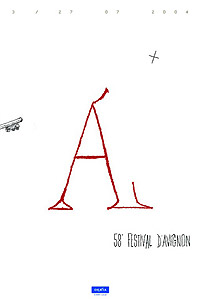
After the 2003 cancellation, exceptional public support helped the Festival resume. Performing-arts workers’ insurance arrangements remained a central concern.
Hortense Archambault and Vincent Baudriller introduced the principle of an associate artist, invited to help shape each edition’s character and thinking.
The first associate artist was Thomas Ostermeier, director of Berlin’s Schaubühne. His productions included Büchner’s Woyzeck in the Cour d’honneur, Ibsen’s Nora (Maison de poupée), Franz Xaver Kroetz’s Concert à la carte and Enda Walsh’s Disco Pigs.
Major German-language theatres featured prominently, including Berlin’s Schaubühne, Volksbühne and Berliner Ensemble, and the Schauspielhaus in Zurich.
Rodrigo García offered a radical critique of consumer society in L’Histoire de Ronald, le clown de McDonald’s.
Rodolphe Burger and Olivier Cadiot closed the Festival in the Cour d’honneur. Audiences returned to the event after the previous year’s interruption.
In the Cour d’honneur that year:
- Woyzeck by Georg Büchner directed by Thomas Ostermeier
- Je suis sang by Jan Fabre directed by Jan Fabre (danse théâtre)
- Peer Gynt by Henrik Ibsen directed by Patrick Pineau
- Concert Rodolphe Burger (music)
2005 — 59th Festival d’Avignon
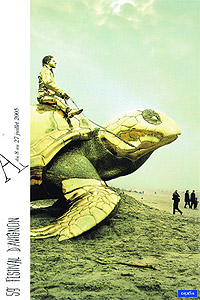
The 2005 edition prompted lively debate about artistic forms and audience expectations.
Associate artist Jan Fabre presented works giving prominence to the body, performance and violent imagery. These choices divided audiences.
Works by Mathilde Monnier, Christian Rizzo and Jan Fabre questioned the boundaries between theatre, dance and performance.
The Cour d’honneur focused largely on choreographic and performance-based works. Elsewhere, Olivier Py presented Les Vainqueurs, a long theatrical journey welcomed by audiences and critics.
Text-based theatre remained present in Brecht’s La Vie de Galilée and Büchner’s La Mort de Danton, directed by Jean-François Sivadier; Hamlet, directed by Hubert Colas; and Hanokh Levin’s Kroum, staged by Krzysztof Warlikowski.
The discussions extended a recurring question in Festival history: how could artistic experimentation be welcomed while maintaining a dialogue with audiences?
In the Cour d’honneur that year:
- Je suis sang by Jan Fabre directed by Jan Fabre (danse théâtre musique)
- L'Histoire des larmes by Jan Fabre directed by Jan Fabre (danse théâtre musique)
- frère&sœur choreography de Mathilde Monnier (dance)
- Apollinaire lecture de poésies par Jean-Louis Trintignant (lecture)
2006 — 60th Festival d’Avignon
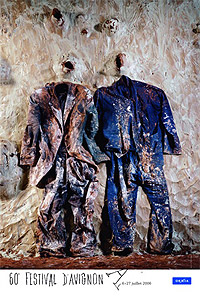
For the sixtieth edition, the associate artist was dancer and choreographer Josef Nadj, born in Yugoslavia’s Hungarian-speaking community.
After the debates of 2005, this edition restored a calmer relationship with audiences.
Bartabas and Zingaro presented Battuta. Peter Brook returned with Sizwe Banzi est mort, set in apartheid-era South Africa.
Éric Lacascade presented Maxim Gorky’s Les Barbares in the Cour d’honneur.
Alain Françon offered several Edward Bond plays. Anatoli Vassiliev was also among the invited directors.
Olivier Py directed a tribute to Jean Vilar, drawing on his writings, in the Cour d’honneur.
In the Cour d’honneur that year:
- Asobu choreography de Josef Nadj (dance)
- Les Barbares by Maxime Gorki directed by Eric Lacascade
- Le Dernier Caravansérail (Odyssées) du Théâtre du Soleil (cinéma)
- Archie Shepp, Tom McClung et Mihály Dresch Quartet (music)
- L'Énigme Vilar lecture de textes de Jean Vilar directed by de Olivier Py
2007 — 61st Festival d’Avignon
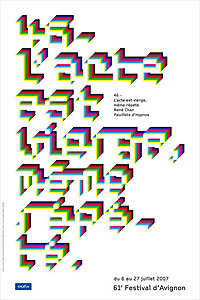
Frédéric Fisbach was the associate artist. He placed René Char at the heart of the edition and presented Feuillets d’Hypnos in the Cour d’honneur, sixty years after the first Semaine d’art.
Valère Novarina presented L’Acte inconnu in the Cour d’honneur. Rodrigo García, Gildas Milin, Éléonore Weber and Christophe Fiat were also among the invited writers.
In the Cour d’honneur that year:
- L'Acte inconnu by Valère Novarina directed by de Valère Novarina
- Quartett by Heiner Müller lecture par Jeanne Moreau et Sami Frey (danse - musique)
- Feuillets d'Hypnos by René Char mis en scène par Frédéric Fisbach
- Le Roi Lear by William Shakespeare directed by Jean-François Sivadier
2008 — 62nd Festival d’Avignon
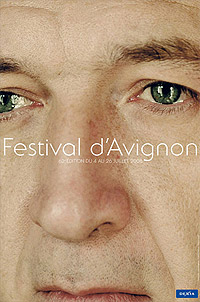
Actress Valérie Dréville was one of two associate artists. She took part in Paul Claudel’s Partage de midi at the Boulbon quarry and offered events centred on her former teacher, Antoine Vitez.
The second associate artist, Romeo Castellucci, drew on Dante’s Divine Comédie: Inferno in the Cour d’honneur, Purgatorio at Châteaublanc and Paradiso in the Célestins church.
Thomas Ostermeier revisited Hamlet in German. Jan Fabre and Wajdi Mouawad, who would become associate artist in 2009, were also present.
The Off’s dates shifted by a few days relative to the Festival. At the Théâtre du Chêne Noir, Philippe Caubère presented his Épilogues.
In the Cour d’honneur that year:
- Inferno inspiré de Divine Comédie de Dante par Romeo Castellucci
- Hamlet by Shakespeare directed by Thomas Ostermeier (théâtre musical)
- La Divine Comédie by Dante lecture de Valérie Dréville (lecture)
- 2008 Vallée choreography by Mathilde Monnier (danse - musique)
2009 — 63rd Festival d’Avignon
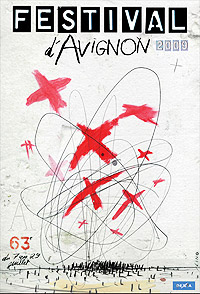
Writer and director Wajdi Mouawad was the associate artist. Born in Lebanon and later living in France and Quebec, he presented Littoral, Incendies and Forêts, brought together in Le Sang des promesses. This long night of theatre in the Cour d’honneur continued until morning.
Jeanne Moreau, present since 1947, returned to the Boulbon quarry in La Guerre des fils de lumière contre les fils de ténèbres, directed by Amos Gitaï.
André Benedetto died on 13 July. Director of the Théâtre des Carmes, he had played a founding role in the emergence of the Off from 1966.
In the Cour d’honneur that year:
- Littoral / Incendies / Forêts trilogie Le Sang des Promesses by Wajdi Mouawad directed by Wajdi Mouawad
- (A)pollonia by Euripide, Eschyle, Hanna Krall, Jonathan Littell, J.M. Coetzee... directed by Krzysztof Warlikowski (Théâtre musical)
- Casimir et Caroline by Ödön von Horvath directed by de Johan Simons
2010 — 64th Festival d’Avignon
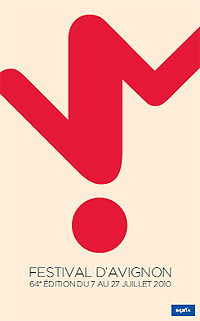
Swiss director Christoph Marthaler was one of two associate artists. His collaborators included set designer Anna Viebrock.
Writer Olivier Cadiot was also an associate artist. Ludovic Lagarde adapted his novel Un nid pour quoi faire for the stage.
The programme brought contemporary writing, dance, music and performance into dialogue.
Christoph Marthaler premiered Papperlapapp in the Cour d’honneur. Jean-Baptiste Sastre also presented Shakespeare’s Richard II there, with Denis Podalydès in the title role, returning to the play from the first edition in 1947.
Angélica Liddell presented La Casa de la fuerza, a long performance about violence against women.
On 14 July, Rodolphe Burger led a dance beneath the Pont d’Avignon.
The Off Festival continued to expand, with a programme exceeding a thousand productions.
In the Cour d’honneur that year:
- Papperlapapp by Christoph Marthaler directed by Christoph Marthaler
- L'Affaire Robinson by Olivier Cadiot (lecture)
- La Tragédie du roi Richard II by Shakespeare directed by de Jean-Baptiste Sastre
- Concert dessiné de Rodolphe Burger
The edition brought a broad audience together for theatre, dance and discussions.
2011 — 65th Festival d’Avignon
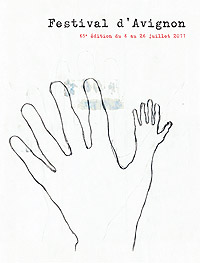
The sixty-fifth edition ran from 6 to 26 July 2011.
Hortense Archambault and Vincent Baudriller’s directorship was extended. They prepared the construction of a permanent rehearsal and residency venue in Avignon: La FabricA, which would open in 2013.
Dancer and choreographer Boris Charmatz, then director of the Musée de la danse in Rennes, was the associate artist. His work included a new production in the Cour d’honneur.
Patrick Pineau directed Nikolaï Erdman’s Le Suicidé at the Boulbon quarry. Wajdi Mouawad presented Des femmes, bringing together Sophocles’s Les Trachiniennes, Antigone and Électre.
In the Cour d’honneur that year:
- L'Enfant création 2011 chorégraphié et mis en scène par Boris Charmatz
- Bloed & Rozen. Het Lied van Jeanne en Gilles (Sang & Roses. Le Chant de Jeanne et Gilles) de Tom Lanoye mis en scène par Guy Cassiers
- Une création de Anne Teresa De Keersmaeker
- Le Condamné à mort de Jean Genet spectacle musical avec Jeanne Moreau et Étienne Daho
- Concert dessiné de Rodolphe Burger
2012 — 66th Festival d’Avignon
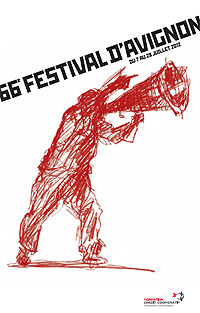
British actor and director Simon McBurney was the associate artist. A co-founder of Complicite who trained with Jacques Lecoq in Paris, he presented Le Maître et Marguerite, after Mikhail Bulgakov, in the Cour d’honneur. He had previously presented Shun-kin at the Festival d’Automne in 2010 and A Disappearing Number at the Théâtre des Amandiers in 2008.